You can't mansplain to a man
But being on the end of condescension can be a helpful reminder of what women often experience

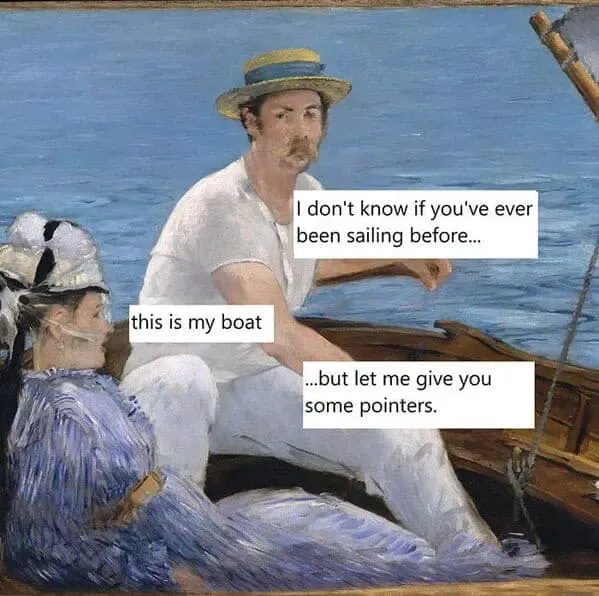
I was on a busy train and managed to find a table seat. Great success! After settling in I exchanged some pleasantries with the man opposite me. About my age, and like me with a laptop open and personal effects spilling across the table. He asked me what I do and I said Earth system science and climate change based at the University of Exeter. He asked if any of my students disputed some of the fundamental elements of climate change. I said most of my climate denial interactions come via emails from retired engineers who have come to the conclusions that humans are not warming the planet, or that the planet is not even warming at all.
There was a beat, and then he said: the thing is, you can’t really compare modern temperature measurements to some of the older records can you - it’s a bit like apples and oranges. I gamely started to talk about temperature reconstructions and how they involve some careful calibrations and multiple sources of evidence. But I knew the game was up. His next topic was natural changes in the Sun and Earth’s orbit, then the observation that there are lots of solar farms being built near where he lives, and all those trees that must have been ripped up to make way for them. He eventually finished his monologue by explaining to me various elements of the UK university sector. At no point did he indicate any particular domain knowledge in these topics beyond a business degree in the early 1990s and some years back he did some work with a satellite company that was doing some sort of remote sensing (I assume).
He was very affable. I think in part he just wanted someone to talk to. I eventually found myself just nodding along until a succession of very loud service announcements on the train made continuation impossible and then I – I’m slightly ashamed to admit - feigned receiving an urgent message on my phone.
I’m still not sure what to do in these situations. One approach I tried in the past is to ask how we can know anything, with the motivation that we arrive at some shared epistemic humility with the recognition that we need to carefully consider data and evidence. Yep, that usually went as badly as you thought it would, so I’ve ditched that approach. Today I thought I would try and talk about the new science on the assessment of Earth's energy imbalance because vital data is coming from the CERES satellite. Unfortunately that was met with complete disinterest.
Another approach is to ask simple questions. What sort of data are you talking about? What sort of orbital changes? Not in some sort of challenging smart arse way, but as an approach to try to surface some of the assumptions or just illuminate some of the reasoning. Dear reader, I must report only very limited success in the past here as well. I have discovered that the less the person knows, the stronger their convictions in their conclusion because they take this as evidence that no one can know anything that contradicts what they know. We end up at the sort of epistemic nihilism of the first approach.
A couple of years ago, I used to write a weekly climate and environment column for the i newspaper, and previous to that I was contributing quite regularly to the Independent. These proved to be the source of the vast majority of my climate change denying emails and often letters from what I assumed were older readers. I tried to reply to them all, but I didn’t always, alas. And some of the letters clearly involved a great deal of effort to produce. They would report on actual experiments that the author had conducted as part of their independent research, including photographs of apparatus, figures, tables, and charts. Sometimes I just couldn’t make sense of what was going on, what was being argued. But I wanted to send some sort of supportive reply because, well it’s a hobby isn’t it? The tone of the letters was often condescending – I had succumbed to the conspiracy, or group think, or herd mentality. A few were clearly quite cross. Some were just threatening, but these were very rate. Online forums contained spicier comments. I remember the discussion about the sort of rope that they could use to hang me.
I am astonished and appalled when a female colleague shares a malicious communication with me – often done with a resigned shrug because that’s the sort of stuff they get all the time. We live in an age of powerful amplification of differences and an increased intolerance of other’s views, identities and lived experiences. This has turbo charged misogyny. The interaction I had today was benign, a very minor diversion from what was going to be another half hour hacking away at a paper on a long train journey. It wasn’t even unpleasant. We departed on good terms. I would say with neither of us the wiser, but what was interesting to me was just how uninterested he was in anything I had to say, even on topics that I am meant to be some sort of expert about.
As a man I can't be mansplained, because that comes from the assumption that being a man confers some sort of knowledge authority over a woman - irrespective of her experiences, abilities, and competences. So the most valuable lesson from today was that I got a glimpse of what those on the receiving end of mansplaining have to deal with on a depressingly regular basis.