Sustainability needs planetary ethology
A key assumption of sustainability is that the planetary-scale technological civilisation humans have constructed is a passive medium through which human intentions are expressed. What if that's wrong, and that civilisation has its own dynamics that shapes & constrains human agency?

Earlier this year I was fortunate enough to organise an entire day just writing. I sat in a room overlooking the sea off Exmouth and started off by browsing old projects and scraps of texts. This turned up an article I had begun a couple of years ago about the technosphere. By the end of the day I had a draft which I then noodled around with for a few weeks before submitting to a journal. It's currently in paper purgatory waiting for reviewers. That's no criticism of the journal - I typically find it very challenging to find reviewers for papers I handle as an editor. In the meantime I thought I would post it here as a preprint. I hope you enjoy it - even if it seems a bit weird!
Sustainability needs planetary ethology
1. Introduction
The Anthropocene concept has done vital work in communicating the scale of human impacts on the Earth system (Steffen et al 2011). The total mass of human civilisation has been estimated at 30 trillion tonnes (Zalasiewicz et al 2017). Humans now move more rock and mineral across the Earth's surface than all the planet's rivers combined (Wilkinson 2005), and fix more nitrogen from the atmosphere than the rest of the biosphere (Vitousek et al 1997). The curve of rising atmospheric carbon dioxide concentrations is testament to the prodigious energies consumed by industrialised societies (Keeling 1976; Crutzen & Stoermer 2000), while land use change, overexploitation, and invasive species have produced rates of extinction on course to approach some of the great mass extinctions (Barnosky et al 2011; Ceballos et al 2017).
Despite the rhetorical power of such framing, the sustainability enterprise that includes the international network of negotiators, scientists, economists, activists, and policymakers working to avoid the worst consequences of human impacts, has made limited progress on the core challenges. The dominant explanatory framework attributes this failure to insufficiencies of human agency: we lack the political will, the correct incentives, and the institutional coordination to produce the changes required to reduce our damage on the natural world. Or perhaps more pointedly with regards the challenge of anthropogenic climate change, we lack sufficient will, incentives, and coordination to overcome vested fossil fuel interests.
In this paper I argue that something important is missing from that diagnosis. The assumption running beneath almost all sustainability discourse is that the planetary-scale technological civilisation humans have constructed is a passive medium through which human intentions are expressed. I propose that this assumption is wrong, and that civilsation can be regarded as an entity with characteristic dynamics of its own that shapes and constrains human agency. I arrive at this conclusion via consideration of the technosphere concept that attempts to describe the totality of global technological civilisation including its physical infrastructure, energy systems, institutions, information networks, and human components as a single planetary-scale system with its own dynamics. As a result, sustainability requires planetary ethology, which I define as the systematic empirical study of what the technosphere does and in some regards intends, approached with the same disciplinary seriousness that ethologists bring to the study of animal behaviour. Just as ethologists do not need to resolve philosophical questions about animal consciousness before describing, modelling, and predicting behavioural repertoires, planetary ethology does not need to resolve metaphysical issues such as whether the technosphere "really" has agency. What it requires is a willingness to treat technosphere dynamics as a fact about the world, in that this is something to be observed and understood on its own terms. In that respect, the use of intentional language as a parsimonious descriptive tool can be productive, and can help clarify the relationship between technosphere theory and agency.
In this paper I produce an initial ethogram for the technosphere that captures five main behaviours: metabolic expansion; infrastructure self-reinforcement; global integration of material and information flows; recruitment of human behaviour; selective responsiveness to constraints. I argue that these behaviours can be empirically determined and have important consequences for how we address contemporary sustainability challenges. The paper proceeds as follows. Section 2 introduces the technosphere concept and its implications for how we understand the relationship between humans and the civilisation they inhabit. Section 3 examines the question of agency and argues that a pragmatic approach dissolves apparent paradoxes about whether the technosphere can meaningfully be said to have goals. Section 4 presents an initial ethogram, and proposes five key behaviours of the Earth system. Section 5 considers possible mechanisms and processes that drives such behaviour. Section 6 considers planetary ethology in the context of environmental regulation and Gaia. Section 7 addresses potential normative and political implications of planetary ethology. The paper concludes with Section 8.
2. The Technosphere
The technosphere concept was initially proposed by geoscientist Peter Haff.
"The technosphere includes the world's large-scale energy and resource extraction systems, power generation and transmission systems, communication, transportation, financial and other networks, governments and bureaucracies, cities, factories, farms and myriad other 'built' systems, as well as all the parts of these systems, including computers, windows, tractors, office memos and humans. It also includes systems which traditionally we think of as social or human-dominated, such as religious institutions or NGOs." (Haff, 2014).
Two features of Haff’s definition are worth underscoring. First, the technosphere is not synonymous with technology in the everyday sense. It includes social institutions, financial systems, and normative structures. This can be understood as including anything that forms part of the infrastructure through which global industrial civilisation reproduces itself. Second, and more provocatively, humans are components of the technosphere, not its authors standing outside it. This reflects the observation that human behaviour is deeply constituted by the technosphere. The languages we speak, the occupations available to us, the foods eat, the beliefs we hold about the world are all substantially shaped by the technological civilisation into which we are born.
Picot & Guillaume (2024) consider Haff’s formulation of the technosphere within a wider discussion of the relationships between humans and technology, and argue that the concept has been present in the scientific literature in some form for at least 50 years. Indeed, of particular relevance to this paper are the concepts of geosphere, biosphere, and noosphere developed by Russian geoscientist Vladimir Vernadsky (Vernadsky 1926). Just as the biosphere framework is required to explain planetary dynamics that a purely geospheric account would struggle to capture - for example large fluxes of reactive gasses such as oxygen and methane into the atmosphere - a new sphere is required to explain the changes to the Earth system since the advent of intelligent beings and civilisation. Intense volcanism could in principle inject large quantities of carbon dioxide into the atmosphere, but it geological process alone cannot explain the simultaneous patterns of continental-scale land use change, novel entity creation, and rapid and specific species extinctions. Vernadsky argued that human technology was reshaping the planet, and ushering a new geological dynamic of the noosphere. The more recent concept of the Anthropocene seeks to capture human impacts via stratigraphy, the scientific study of rock strata on the basis that human interactions within the Earth system are now so significant, that they are being recorded in the creation of new rocks, and thus we are leaving an indelible lithostratigraphic marker (Crutzen & Stoermer 2000; Crutzen, 2006).
The technosphere departs from noosphere and Anthropocene framing most sharply in the position it assigns to human agency. Both noosphere and Anthropocene tends to cast humanity as an important driver of planetary change, even when that driving is an unintended by-product. The technosphere concept raises the possibility that the direction of causation is reversed. Haff formalises this in a set of six rules governing human-technosphere interactions (Haff 2014). Two are particularly relevant here. The “rule of impotence” holds that most individual humans cannot significantly influence the behaviour of large technological systems. The “rule of performance” states that most humans must perform at least some tasks that support the metabolism of the technosphere. These rules invert the common-sense picture of technology as a tool that humans deploy in pursuit of human ends. Haff argues that humans are, in important respects, deployed by the technosphere in pursuit of technosphere ends. The notion that technology uses us as much as we use technology is not novel (Heidegger 1954; Stiegler 1998). However, this does have important consequences with regards contemporary sustainability challenges, and the amount of agency that human have within the technosphere, with Haff arguing that this may be much more limited than is commonly assumed. If Haff is correct then, for example, humans may not be able to produce the large-scale change in industrial processes required to rapidly phase out fossil fuels even if in some ways they intend it. Humans intentions would not be sufficient because the agency of the technosphere must also in some sense be accommodated.
3. Teleology, Teleonomy, and the Intentional Stance
The question of whether the technosphere has agency is, at first glance, philosophically treacherous. Attributing purpose or intention to a non-biological system risks the charge of anthropomorphism, while denying it entirely risks obscuring the very dynamics that make the technosphere consequential for sustainability. I navigate this tension by drawing on three related but distinct concepts: teleology, teleonomy, and the intentional stance. What is important is not whether the technosphere really has goals, but if treating it as if it does allows us to develop a productive approach to sustainability.
The history of natural sciences is littered with debates about teleology, the attribution of purpose or goal-directedness to natural systems, and the strong reaction against it that characterised much of twentieth-century scientific thinking (Mayr 1974). The paradigm of evolution via natural selection as codified in neo-Darwinian theory explains the shape, forms, and behaviours of complex organisms as the result of much simpler lower-level rules and organisation. In its more extreme interpretations, organisms are merely vessels through which genes express and reproduce themselves (Dawkins 2016). This is in stark contrast to design arguments (often but not exclusively embedded within theology) in which biological and other complex systems are evidence of intentional design being exercised by some designer (Nagel 2008). A central dogma in contemporary science, is that evolutionary systems do not “want” anything, but are merely following natural laws. How are we to then understand the technosphere which appears to be accompanied by a sense of higher-level agency? It may be assumed that any sort of agency being exhibited here, must simply be the result of the lower-level agency of the humans that inhabit and built the technosphere.
Haff previously proposed that the technosphere can be seen as exhibiting a sort of intrinsic agency (Haff et al 2019), that arises as a result of simple dynamics. Consider a boulder rolling down a valley. In a trivial sense, the boulder “wants” to reach the lowest point. It exhibits what we might call teleonomy: goal-directedness that emerges entirely from physical dynamics, in this instance explained by energy minimisation in a simple dynamical system. The ball does not have intentions, beliefs, or preferences. Yet teleological language captures a real feature of the system, namely its characteristic trajectory toward an attractor state. This can be seen as compatible with a notion of agency that is derived from Ashby’s cybernetic concept of ultrastability (Ashby 1960) in that dynamical systems that persist do so because of emergent regulatory processes that can be seen as conferring a sense of goal-directedness and purpose. That the boulder is not an intentional agent does not mean that its characteristic trajectories cannot be usefully described in goal-directed terms. The distinction between teleonomy and teleology is where discussions on technosphere agency and intentions risk becoming stuck. The resolution comes via Daniel Dennett's concept of the intentional stance (Dennett, 1987). Dennett distinguishes three stances one can adopt toward a system: the physical stance (describing it in terms of physical laws), the design stance (describing it in terms of what it was designed to do), and the intentional stance (describing it as if it has beliefs, desires, and goals). Crucially, Dennett's argument is that adopting the intentional stance is justified not by metaphysical facts about the system's inner life, but by its predictive and explanatory utility. When treating a system as an intentional agent generates better predictions of its behaviour than treating it as mere mechanism, the intentional stance is not just a convenient shorthand, but the epistemically appropriate tool. Dennett applies this argument to thermostats, chess-playing computers, evolution, and corporations. The technosphere is a far more complex and behaviourally rich system than any of these. If the intentional stance is warranted for a thermostat, the question of whether it is warranted for the technosphere is at least worth taking seriously. I propose that we currently view the technosphere through a flawed design stance, in that it is assumed that the planetary-scale civilisation does what humans designed it to do. However, given its scale and complexity, an intentional stance may well provide a better route to more robust predictions.
To be clear, this is not a claim that the technosphere has mental states, consciousness, subjective experience, or is alive. It is a claim about the pragmatic utility of intentional descriptions. The technosphere behaves as if it has goals. What it is like to be a technosphere is a separate question that is beyond the scope of this paper. What matters for the sustainability enterprise is that the technosphere's characteristic dynamics are real and consequential, and that intentional language is the most parsimonious way to describe them. To such ends, we can take inspiration from biology. Ethology, the scientific study of animal behaviour in natural conditions, offers a productive model for how the intentional stance can be applied to the technosphere. Ethologists working in the tradition of Lorenz, Tinbergen, and von Frisch did not resolve debates about animal consciousness before making significant scientific progress. They observed, described, and modelled behavioural repertoires in the light of different conditions and set of stimuli (Tinbergen 1963). They used intentional language, for example a stickleback “wants” to defend its territory, while remaining agnostic about the deeper metaphysics. Early ethologists were sometimes accused of anthropomorphism, of projecting human qualities onto animals in ways that distorted scientific understanding. That accusation was sometimes fair. But the appropriate response was not to abandon intentional descriptions, but to use them more carefully, more empirically, and with clearer awareness of the distinction between predictive utility and metaphysical claim. Planetary ethology address the same challenge not by abandoning mechanistic descriptions, but to supplement them with intentional descriptions, where such descriptions are useful. While we do this, we must be aware of the risk of phusimorphism -denying any sort of higher-level dynamics to a complex system while insisting that its behaviour can be exclusively explained by lower-level reductionist mechanisms (Latour et al 1992). This caution could be applicable to many complex systems. Here, I argue that by reducing the technosphere to mere mechanism, we risk denying it the form of agency that would make it intelligible as a powerful force shaping the Earth system. To do so would represent a significant blind spot when it comes to the formulation and implementation of sustainability policy.
4. A Planetary Ethogram
Planetary ethology begins with empirical descriptions: what does the technosphere characteristically do? What are its stable behavioural tendencies across varying conditions? What stimuli elicit what responses? Such questions are scattered across Earth system science, complexity theory, and the social study of technology. Of closest relevance would be technosphere science proposed by Carsten Herrmann-Pillath which reaches from physics to the social sciences and humanities, and within which agency is no longer seen as a property exclusive to humans, but as being distributed across networks of ontologically diverse entities (Herrmann-Pillath 2018). A preliminary a catalogue of characteristic technosphere behaviours, might include the following:
Metabolic Expansion
The most robust behavioural tendency of the technosphere is growth in energy and material consumption. This growth has persisted across centuries, across radically different political systems, and through major disruptions including world wars, financial crises, and pandemics. The post-WWII acceleration of this growth, termed the Great Acceleration (Steffen et al 2015) can be be understood as an intensification of this dynamic as the result of an acceleration of utilisation of high energy density fossil fuels, see Figure 1. From the perspective of planetary ethology, this is an example of the technosphere's drive toward ever-greater dissipation of energy gradients, analogous to the metabolic drive of a biological organism. When new energy gradients become accessible, the technosphere tends to organise structures capable of exploiting them, thereby increasing overall rates of energy dissipation.
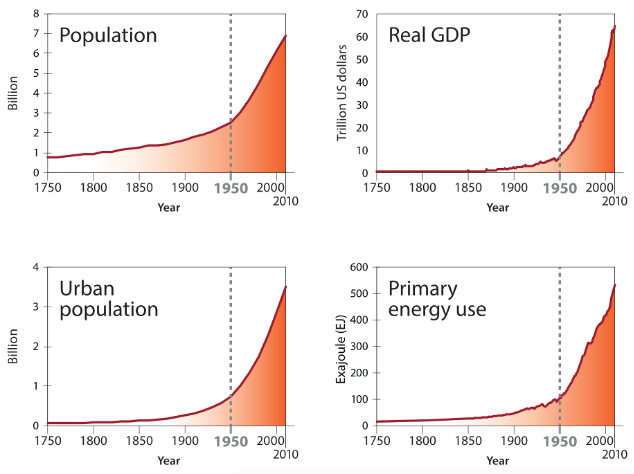
Figure 1. Reproduced from (Steffen et al 2015). Four features of the Great Acceleration that represent the significant increase in the mass and metabolism of the technosphere.
Infrastructure self-reinforcement
Technological systems exhibit path dependence in which existing infrastructures constrain the range of possible future developments. Built environments, electrical grids, road networks, supply chains, and digital communication architectures bias subsequent innovation toward compatibility with already-deployed systems. This produces a form of behavioural inertia in that once large-scale infrastructures exist, their continued utilisation becomes the default trajectory because replacement entails significant energetic and coordination costs. Such persistence resembles niche construction in biological systems, where organisms modify environments in ways that subsequently shape their own evolutionary trajectories (Odling-Smee et al 1996). A contemporary example within the context of energy transitions, would be the economic concept of stranded assets which has been proposed as a potentially important constraint on the phase out of fossil fuels (Bos et al 2019).
Global integration of material and information flows
The technosphere displays a tendency toward increased connectivity among its components. Prior to civilisation, and even complex eukaryotic life, the emergence of biogeochemical cycles linked geological to biological processses with the result of large movements of materials through the Earth system (Volk 1998). The advent of human civilisation and accompanying trade routes and migration have significantly increased material and information flow. The invention of analogue electronic communication systems such as the telegraph and telephone switching networks produced a step change in the rate of information flow. Digital information systems, in particular the internet, have massively increased connectivity and further reduced latency. This has produced a global information system that is increasingly sensitive to perturbations propagating through highly connected networks, while continuing to accelerate compute capabilities in ways compatible with Moore’s law (Mack 2011).
Recruitment of human behaviour
The technosphere actively shapes the behaviour of its human components in ways that are compatible with its metabolic requirements. Labour markets, educational systems, financial incentives, and cultural norms all tend to direct human activity toward the maintenance and expansion of the technosphere. Haff's rule of performance - that most humans must perform tasks that support the technosphere's metabolism - can be understood as a description of a relationship of mutual constitution: the technosphere and its human components co-evolve in ways that tend to reinforce technosphere growth. The promotion of economic growth which along with national security serves as the prime directive for almost all governments, can be seen as a political instantiation of recruitment of human behaviour to further the expansion of the technosphere (Schmelzer 2016).
Selective responsiveness to constraints
The technosphere has demonstrated, in specific cases, the ability to reorganise rapidly in the face of serious threats to its continued functioning. The response to the discovery of the ozone hole, the Montreal Protocol and rapid phase-out of CFC chemicals, is a significant example (Velders et al 2007). Donges et al. (2017) cite this alongside the German nuclear decommissioning programme as evidence that collective human agency can produce meaningful technospheric change. From the perspective of planetary ethology, these cases are instructive not primarily as evidence of human agency, but as demonstrations of the conditions under which the technosphere responds to pressure: when the threat is concrete, proximate, and poses a risk to the technosphere's growth, the system can respond at speed. It is important to note, that neither CFC phase out or nucear decommissioning resulted in a decrease in global energy and material consumption.
These observations are not novel in themselves. What planetary ethology contributes is a framework that treats them as elements of a behavioural repertoire that can be studied systematically, modelled, and used to generate predictions about how the technosphere will respond to different classes of intervention.
5. Planetary Mechanisms
If it is possible to discern the behaviours of the technosphere, then it may be possible to elucidate the mechanisms and processes that drives such behaviours. This would be key if one is motivated to interact with the technosphere in order to change its behaviour. One key mechanism would appear to be dissipation of energy. The transitions from energy generation being dominated by biomass then coal, and then from coal to oil, and the current contested transition toward renewable electricity are not merely changes in fuel source. They can be seen as major evolutionary events that restructure the technosphere's metabolic organisation, analogous in some respects to the major evolutionary transitions in biological history (Szathmáry & Smith 1995). Over geological timescales, the emergence of the technosphere can be explained in terms of increases in energy and material dissipation in which evolutionary innovations allow the biosphere to transcend previous constraints, as shown in Figure 2. Step changes in energy capture were produced with the evolution of oxygenic photosynthesis, and then the colonisation of land by life. The Neolithic revolution saw humans significantly appropriate and then enhance primary productivity with agriculture and settled lifestyles. The industrial revolutions produced another step change in energy capture by utilising the fossil fuel of coal, which formed the energetic basis to develop the industrial and technological capability for large-scale extraction of oil and gas.
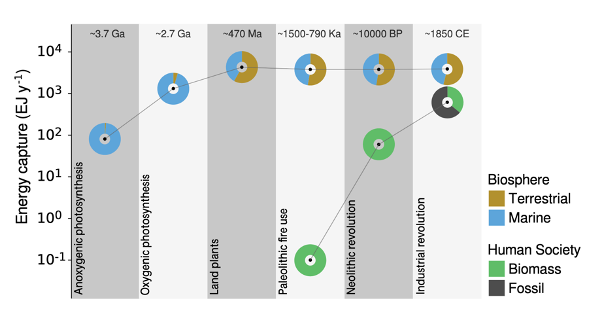
Figure 2: Reproduced from Lenton et al (2016). Energy capture in the biosphere and human society. Dates indicate beginning of the respective revolution, energy estimates are given for dates where energy regimes had matured. The Great Acceleration of the Anthropocene can be regarded as the next revolution in energy capture with exponential increases in photovoltaic electricity generation representing a significant increase in the total amount of energy available to the technosphere.
While we are witnessing an exponential increase in the deployment of photovoltaic electricity generation, we have yet to see the rapid phase out of fossil fuels. Thus far, at a global level, renewable systems have added to, not replaced hydrocarbon-based energy systems as shown in Figure 3. This is despite renewable systems such as a solar farm being magnitudes more efficient than a coal-fired thermal power plant. The notion that increasing energy efficiency increases rather than decreases total energy consumption is not new. Jevons famously presented the paradoxical increase in coal use with increased efficiencies in the 19th Century (Jevons 1886).
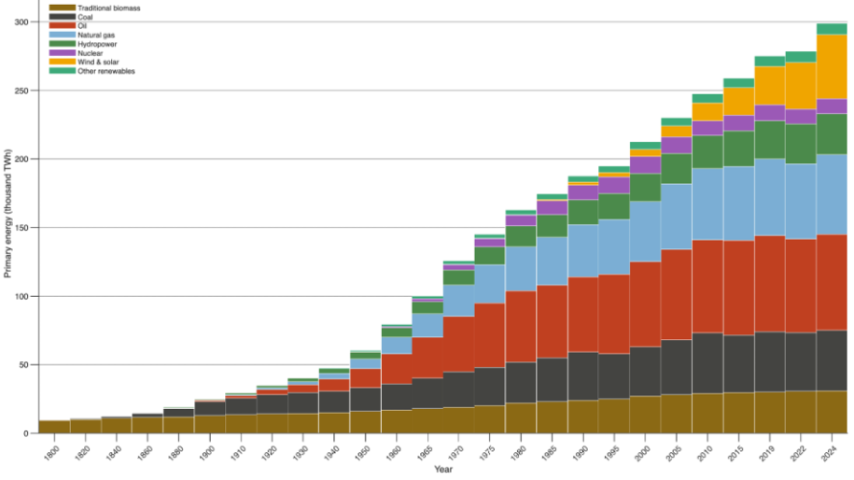
Figure 3: Primary energy production by type, data from Smil (2018) and Statistical review of world energy (2025). The emergence of new energy sources adds to existing global energy supply. It remains to be seen at what rate a global phase out of coal, oil, and gas can be affected.
In the context of planetary ethology, the increase of energy use and stubborn persistence of legacy energy systems can be seen as an example of autocatalysis in which the technosphere utilises existing energy systems to develop access to new energy gradients, with a net increase in total energy use (Galbraith et al 2025). One explanation for this behaviour is essentially thermodynamic: the Earth receives low entropy energy from the Sun which it dissipates into higher entropy energy and is then radiated out to space. The emergence of life and a complex biosphere accelerates this dissipation. Directionality can arise via extremum principles in which the Earth system is more likely to evolve towards states that increase the rate of entropy production (Dyke & Kleidon 2010), and maximizing the dissipating of energy gradients (Kleidon 2024), with technological civilization further accelerating such trends (Haff 2013). Some thermodynamic modelling approaches suggest strong structural constraints on rapid change within the technosphere, because an increasing amount of energy is required to effectively maintain the functioning of existing structures and systems (Garrett 2014). This may even suggest that there are not only limits to technosphere change, but that abrupt increases in mortality that could be characterized as collapse are likely. The notion of civilization collapse as a result of increased complexity was first proposed by Tainter (1988). A more recent thermodynamic mechanism has similar features, in that it posits that the energetic burden of existing technosphere structures means that humans are constrained with regards to how rapidly they would be able to engineer energy transitions that phase out fossil fuel use (Garret et al 2020).
6. Planetary Ethology and Gaia
It is instructive to consider planetary ethology with regards another concept that invoked planetary-scale behaviours: Gaia. Both planetary ethology and the Gaia hypothesis propose that planetary-scale systems exhibit dynamics that are not reducible to the behaviour of their individual components. Lovelock's original insight was that the Earth's atmosphere is in a state of significant thermodynamic disequilibrium, as evidenced by the coexistence of reactive gases such as oxygen and methane that, left to chemistry alone, would rapidly reach equilibrium. Lovelock reasoned that this disequilibrium is actively maintained by the biosphere (Lovelock 1972; Lovelock & Margulis 1974). The original Gaia hypothesis proposed that the coupled Earth-life system tends to regulate environmental conditions within ranges hospitable to widespread life. Subsequent work formalised potential mechanisms, particularly via Daisyworld modelling that showed environmental regulation can arise from competitive interactions among organisms without any requirement for foresight or planning (Watson & Lovelock 1983; Wood et al 2008; Dyke & Weaver 2013), with later work demonstrating that sequential selection among planetary states can explain the persistence of regulation over very large spatial and temporal scales (Lenton et al 2018). While this regulatory behaviour need not imply foresight or planning, early criticisms of the original Gaia hypothesis argued that the very idea of regulation “by and for the biosphere” came with significant teleological baggage (Dawkins 1983). Such criticisms can be addressed either using either Haff’s intrinsic agency, or the application of the intentional stance as advocated here. For example, one does not need to argue that the Gaian Earth system “wants” to maintain conditions for abundant life, but that such planetary-scale regulation can emerge from multiple interacting mechanisms and processes, none of which requires foresight and planning. However, at the macro or planetary-scale, adopting the intentional stance can be appropriate in that it allows us to talk meaningfully about the dynamical behaviours of the Earth system.
The technosphere can be seen as the emergence of a new class of feedback loops within a larger Gaian system that are mediated not by biogeochemical cycles but by computation, logistics, finance, and infrastructure. These feedbacks are faster and more globally integrated than most biogeological feedbacks, and so far are profoundly destabilising. For example, no natural process in the biosphere’s entire history has released carbon dioxide into the atmosphere as rapidly as industrialised societies. In that respect, the technosphere is not a regulator but a disturber. This is actually consistent with a Gaian formulation of the Earth system, because disruption of the biosphere between regulatory states has occurred over geological time, with the Great Oxidation event ~2.3-2.4Ga being the most profound (Holland 2002). The evolution of oxygenic photosynthesis produced large increases of concentrations of oxygen in the atmosphere and oceans. This would have had a devastating impact on current forms of life as oxygen is highly reactive and increases in concentration would have essentially poisoned the biosphere. This upending of life set the stage for the evoution of complex eukaryotic life, and eventually intelligent beings and technology. In that context, human-caused climate change that results from the large-scale burning of fossil fuels could be regarded as the latest example of a Gaian Earth system that continues to evolve. We may even dub the recent and rapid rise in carbon dioxide levels in the atmosphere as the Great Emission. Like the Great Oxidation this is coming at great cost to existing ecosystems and species. Will this produce new entities that have the capacity to increase the biosphere’s energy capture in the future?
Gaia is also instructive to planetary ethology, because while the Earth system may regulate environmental variables necessary for complex biospheres, this does not - pace Doolittle (1981) - make Gaia “motherly” or have any interest in benefiting any individual species, including Homo sapiens. If humans want to participate in planetary-scale regulation, then they will need to purposefully work towards such ends. This has been proposed via the notion of Gaia 2.0, where new reflexive capacities of the Earth system arise from humans being able to produce models of possible futures and then work to move towards or away from them (Lenton and Latour 2018). The deterministic conceptions of the technosphere from Haff and Garrett suggests that while humans may be able to perceive future risks, they may be relatively powerless to avoid them because human reflective behavioural repertoires are simply incorporated into existing dynamics of technosphere expansion. This goes beyond the now well established limitations of the information deficit model (Simis et al 2016). In terms of the initial planetary ethogram above, efforts to exercise Gaia 2.0 control could face significant barriers.
7. Normative Implications
The planetary ethology framework has implications for how sustainability challenges should be approached. The dominant model of identifying the desired outcome, designing policies to change human behaviour, implementation and enforcement, treats the technosphere as a passive entity that will transmit human intentions into planetary outcomes. The planetary ethology framework proposes an alternative starting point, which is given what we know about the technosphere's behaviour, what class of interventions are likely to be successful? Consider the situation of a swimmer caught in a powerful rip tide that is moving them further away from the shore. Swimming against that tide will quickly lead to exhaustion. The recommended behaviour is to swim parallel to the shore until it dissipates, then return to safety. The rip tide's dynamics are a fact which the skilled swimmer does not deny or try to overpower. They work with the grain of the system. With regards the sustainability challenge of human-caused climate change, we are attempting to turn the tides of history - from the age of fossil fuels to renewables. Policies that promote the deployment of renewable energy systems can be seen as swimming with the tide of the technosphere in that it has the potential to further increase energy and material consumption. But if these are not accompanied with efforts to close off the fossil fuel spigot, then emissions will continue to rise. Policies that directly challenge energy use would be to attempt to swim against the tide of the technosphere and it should be expected they will be strongly resisted. This could exhaust political capital and dissipate collective human agency. Skilled sustainability approaches would be mindful of these dynamics.
Describing the technosphere as a quasi-autonomous system with its own dynamics has the potential to depoliticise what are deeply historically specific, and contested arrangements involving capitalism, colonialism, and particular property regimes. The technosphere concept could be deployed as an ideologically conservative framework presented in the guise of supposedly objective and value-free Earth system science. Consequently, planetary ethology is politically dangerous because it provides a ready excuse for inaction. This is related to concerns the stem from the naturalistic fallacy or the “is-ought problem” in which what is good is defined in terms of what is considered natural (Moore 1903). But planetary ethology does not decrease the moral imperatives for sustainability. For example, the disease of cancer can be considered entirely natural, in that cancerous cells are a feature of nearly all animals. This does not stop people developing moral arguments about how societies should allocate resources for the research and treatment of cancerous diseases. Moreover, ethologists can adopt moral positions about the animals they are observing. A biologist watching a tiger stalking one of their colleagues should not remain passive. In fact, they have a moral responsibility to alert them of the danger. With regards the technosphere, the alternative - treating the technosphere as passive and locating the entire explanatory and normative burden on human agency - generates its own moral hazard. It supports a model of sustainability that is systematically incomplete, and produces interventions that are structurally misaligned with the system people are trying to change.
The fact that the technosphere exhibits strong behavioural tendencies does not mean all human actions should be subordinated to such ends. For example, there are many reasons to resist technosphere growth that produces environmental degradation, biodiversity loss, and greenhouse gas emissions. Nor does planetary ethology mean fatalism. For example, the behavioural envelope of a species defines tendencies, not necessities. Individual organisms regularly behave outside of typical patterns, especially under novel conditions. The same applies to the technosphere. Describing its characteristic dynamics does not rule out the possibility of disrupting or redirecting them. It simply demands that we start from an accurate description of what we are dealing with.
8. Conclusion
Growth is a key behaviour of the technosphere. Is growth good? While economic growth has had a transformative impact on the lives of billions of people, with many government policies explicitly framed around social issues such as poverty alleviation, the development of the technosphere cannot be explained exclusively in terms of increased collective benefits to humans. For example, the transitions from biomass to coal during the industrial revolution in the UK were associated with reductions in the wellbeing of large proportions of the human population (Gallardo-Albarrán & de Jong 2021), while the much earlier development of sedentism and the intensification of agriculture in the Neolithic, was associated with an increase in infectious disease and nutritional deficiencies particularly affecting infants and children (Armelagos et al 1991). This is consistent with the planetary ethology view that human wellbeing may be a constraint on, rather than the goal of, technospheric behaviour. The technosphere must maintain conditions sufficient for its human components to function. This does not make it its organising goal. Whether Homo sapiensbecomes extinct is, from the technosphere's perspective as reconstructed by planetary ethology, a secondary consideration. In the absence of another species or entity that provides similar technologies that dissipates energy and consumes materials, then this secondary consideration is in effect the technosphere’s primary consideration. If technological civilisation is not organised around human outcomes, then we must confront the consequences. We are already on course to significantly exceed safe thresholds for climate change and have transgressed multiple other planetary boundaries (Richardson et al 2023). These are the observable results of a system optimising for something other than the welfare of its inhabitants.
The planetary ethology framework can speak directly to debates within degrowth and postgrowth economics. Degrowth scholarship has argued that the coupling of human welfare to GDP growth is contingent rather than necessary. Rich societies could, in principle, maintain or improve wellbeing while reducing material and energy consumption (Kallis 2018) and that globally, there are sufficient resources to ensure all of humanity is able to experience decent lives (O’Neill et al 2018). Coordinating economic policies beyond growth opens the opportunities to envision institutional arrangements in which economic activity is organised around sufficiency and care (Raworth 2012; Jackson 2017). Planetary ethology can help reframe the challenges such proposals face. For example, if the technosphere exhibits metabolic expansion as a robust behavioural tendency, then under what conditions can a system with these characteristic dynamics undergo a sustained reduction in throughput without systemic collapse? The historical record since industrialisation offers scant examples in which energy and material consumption decreases, and those that exist such as wartime contractions, collapse of the USSR, and the more recent Covid19 pandemic, were associated with increased human suffering rather than planned flourishing, which is precisely what degrowth proponents seek to avoid (Parrique et al 2019).
This does not mean it is not possible for the technosphere to decrease in managed and sustained ways. My claim is that planetary ethology can provide insights and details into technosphere dynamics which may prove crucial for the successful implementation of policies that centre on human wellbeing. In doing so, planetary ethology could offer insights into how to live well within the technosphere, how to steer, redirect, and work with it in ways that sustains rather than undermines human and non-human flourishing.
References
Armelagos, G.J., Goodman, A.H. and Jacobs, K.H., 1991. The origins of agriculture: Population growth during a period of declining health. Population and environment, 13(1), pp.9-22.
Ashby, W.R., 1960. Design for a Brain. Chapman and Hall, London.
Barnosky, A.D. et al. 2011. Has the Earth's sixth mass extinction already arrived? Nature, 471, 51–57.
Bos, K. and Gupta, J., 2019. Stranded assets and stranded resources: Implications for climate change mitigation and global sustainable development. Energy Research & Social Science, 56, p.101215.
Ceballos, G. et al., 2017. Biological annihilation via the ongoing sixth mass extinction signalled by vertebrate population losses and declines. Proceedings of the National Academy of Sciences, 114(30), E6089–E6096.
Crutzen, P.J., 2006. The “anthropocene”. In Earth system science in the anthropocene (pp. 13-18). Berlin, Heidelberg: Springer Berlin Heidelberg.
Crutzen, P.J. & Stoermer, E.F., 2000. The Anthropocene. Global Change Newsletter, 41, 17–18.
Dawkins, R., 1983. The Extended Phenotype. Oxford University Press.
Dawkins, R., 2016. The Selfish Gene. Oxford University Press.
Dennett, D.C. 1987. The Intentional Stance. MIT Press, Cambridge, MA.
Donges, J.F., Lucht, W., Müller-Hansen, F. and Steffen, W., 2017. The technosphere in Earth System analysis: A coevolutionary perspective. The Anthropocene Review, 4(1), pp.23-33.
Doolittle, W.F., 1981. Is nature really motherly? CoEvolution Quarterly, 29, pp.58-63.
Dyke, J. and Kleidon, A., 2010. The maximum entropy production principle: Its theoretical foundations and applications to the earth system. Entropy, 12(3), pp.613-630.
Dyke, J.G. and Weaver, A.J., 2013. The emergence of environmental homeostasis in complex ecosystems. PLOS Computational Biology, 9(5), p.e1003050.
Gallardo-Albarrán, D. and De Jong, H., 2021. Optimism or pessimism? A composite view on English living standards during the Industrial Revolution. European Review of Economic History, 25(1), pp.1-19.
Galbraith, E.D., Faisal, A.A., Matitia, T., Fajzel, W., Hatton, I., Haberl, H., Krausmann, F. and Wiedenhofer, D., 2025. Delineating the technosphere: definition, categorization, and characteristics. Earth System Dynamics, 16(4), pp.979-999.
Garrett, T.J. 2014. Long-run evolution of the global economy: 1. Physical basis. Earth’s Future, 2(3), 127–151.
Garrett, T.J., Grasselli, M. and Keen, S., 2020. Past world economic production constrains current energy demands: Persistent scaling with implications for economic growth and climate change mitigation. PLoS One, 15(8), p.e0237672.
Haff, P.K., 2013. Maximum entropy production by technology. In Beyond the Second Law: Entropy Production and Non-Equilibrium Systems (pp. 397-414). Berlin, Heidelberg: Springer Berlin Heidelberg.
Haff, P.K. 2014. Humans and technology in the Anthropocene: Six rules. The Anthropocene Review, 1(2), 126–136.
Haff, P., Zalasiewicz, J., Waters, C.N., Williams, M., Barnosky, A., Leinfelder, R. and do Sul, J.A.I., 2019. The technosphere and its physical stratigraphic record. In Zalasiewicz, J. et al. (eds.), The Anthropocene as a geological time unit. Cambridge University Press, pp.137-155.
Heidegger, M., 1954. The question concerning technology. In Technology and values: Essential readings, 99, p.113.
Herrmann-Pillath, C. 2018. The case for a new discipline: Technosphere science. Ecological Economics, 149, 212–225.
Holland, H.D., 2002. Volcanic gases, black smokers, and the Great Oxidation Event. Geochimica et Cosmochimica Acta, 66(21), pp.3811-3826.
Jackson, T., 2009. Prosperity without growth: Economics for a finite planet. Routledge, UK.
Jevons, W.S., 1886. The Coal Question; An Inquiry Concerning the Progress of the Nation, and the Probable Exhaustion of Our Coal Mines. Macmillan & Co, UK.
Kallis, G., 2018. Degrowth (Vol. 7). Newcastle upon Tyne: Agenda Publishing.
Keeling, C.D. et al. 1976. Atmospheric carbon dioxide variations at Mauna Loa Observatory, Hawaii. Tellus, 28(6), 538–551.
Kleidon, A., 2024. The second law of thermodynamics, life and Earth’s planetary machinery revisited. Physics of Life Reviews, 51, pp.382-389.
Latour, B., Bijker, W.E. and Law, J., 1992. Where are the missing masses? The sociology of a few mundane artifacts. In Shaping Technology/Building Society: Studies in Sociotechnical Change, pp.225-258.
Lenton, T.M. and Latour, B., 2018. Gaia 2.0. Science, 361(6407), pp.1066-1068.
Lenton, T.M., Daines, S.J., Dyke, J.G., Nicholson, A.E., Wilkinson, D.M. and Williams, H.T., 2018. Selection for Gaia across multiple scales. Trends in Ecology & Evolution, 33(8), pp.633-645.
Lenton, T.M., Pichler, P.-P. and Weisz, H. 2016. Revolutions in energy input and material cycling in Earth history and human history. Earth System Dynamics, 7(2), 353–370.
Lovelock, J.E. 1972. Gaia as seen through the atmosphere. Atmospheric Environment, 6(8), pp.579-580.
Lovelock, J.E. and Margulis, L., 1974. Atmospheric homeostasis by and for the biosphere: The Gaia hypothesis. Tellus, 26(1-2), pp.2-10.
Mack, C.A., 2011. Fifty years of Moore’s law. IEEE Transactions on Semiconductor Manufacturing, 24(2), pp.202-207.
Mayr, E. 1974. Teleological and teleonomic: A new analysis. Boston Studies in the Philosophy of Science, 14, 91–117.
Moore, G.E. 1903. Principia Ethica. Cambridge University Press.
Nagel, T., 2008. Public education and intelligent design. Philosophy & Public Affairs, 36, p.187.
Odling-Smee, F.J., Laland, K.N. and Feldman, M.W., 1996. Niche construction. The American Naturalist, 147(4), pp.641-648.
O’Neill, D.W., Fanning, A.L., Lamb, W.F. and Steinberger, J.K., 2018. A good life for all within planetary boundaries. Nature Sustainability, 1(2), pp.88-95.
Parrique, T., Barth, J., Briens, F., Kerschner, C., Kraus-Polk, A., Kuokkanen, A. and Spangenberg, J.H., 2019. Decoupling Debunked: Evidence and Arguments Against Green Growth as a Sole Strategy for Sustainability. European Environmental Bureau.
Picot, P. and Guillaume, B., 2024. The controllability of the Technosphere, an impossible question. The Anthropocene Review, 11(1), pp.91-109.
Raworth, K., 2012. A safe and just space for humanity: can we live within the doughnut? Oxfam.
Richardson, K., Steffen, W., Lucht, W., Bendtsen, J., Cornell, S.E., Donges, J.F., Drüke, M., Fetzer, I., Bala, G., Von Bloh, W. and Feulner, G., 2023. Earth beyond six of nine planetary boundaries. Science Advances, 9(37).
Schmelzer, M., 2016. The hegemony of growth: the OECD and the making of the economic growth paradigm. Cambridge University Press, UK.
Simis, M.J., Madden, H., Cacciatore, M.A. and Yeo, S.K., 2016. The lure of rationality: Why does the deficit model persist in science communication? Public Understanding of Science, 25(4), pp.400-414.
Smil, V., 2018. Energy and civilization: a history. MIT press, USA.
Statistical review of world energy 2025. Energy institute, UK.
Steffen, W., Grinevald, J., Crutzen, P. & McNeill, J., 2011. The Anthropocene: conceptual and historical perspectives. Philosophical Transactions of the Royal Society A, 369(1938), 842–867.
Steffen, W. et al. 2015. The trajectory of the Anthropocene: The Great Acceleration. The Anthropocene Review, 2(1), 81–98.
Stiegler, B., 1998. Technics and Time, 2: Disorientation (Vol. 2). Stanford University Press.
Szathmáry, E. and Smith, J.M., 1995. The major evolutionary transitions. Nature, 374(6519), pp.227-232.
Tainter, J. 1988. The Collapse of Complex Societies. Cambridge University Press, UK.
Tinbergen, N., 1963. On aims and methods of ethology. Zeitschrift für Tierpsychologie, 20(4), pp.410-433.
Velders, G.J., Andersen, S.O., Daniel, J.S., Fahey, D.W. and McFarland, M., 2007. The importance of the Montreal Protocol in protecting climate. Proceedings of the National Academy of Sciences, 104(12), pp.4814-4819.
Vernadsky, V.I. 1926. The Biosphere. Copernicus Books (1998 English translation).
Vitousek, P.M. et al., 1997. Human alteration of the global nitrogen cycle: Sources and consequences. Ecological Applications, 7(3), 737–750.
Volk, T. 1998. Gaia’s Body. Springer, New York.
Watson, A.J. and Lovelock, J.E., 1983. Biological homeostasis of the global environment: The parable of Daisyworld. Tellus B, 35(4), pp.284-289.
Wilkinson, B.H., 2005. Humans as geologic agents: A deep-time perspective. Geology, 33(3), 161–164.
Wood, A.J., Ackland, G.J., Dyke, J.G., Williams, H.T. and Lenton, T.M., 2008. Daisyworld: A review. Reviews of Geophysics, 46(1).
Zalasiewicz, J. et al., 2017. Scale and diversity of the physical technosphere: A geological perspective. The Anthropocene Review, 4(1), pp.9-22.