People power will drive climate action
The People's Emergency Briefing shows how together we can end fossil fuels - but immense forces are alined against us

I attended a screening of People’s Emergency Briefing in Plymouth’s Art Cinema on Friday. Last month I joined a screening in Exeter’s Phoenix, and next week I will be at Crediton. The film is based on the National Emergency Briefing held last year in London. It really is excellent, and after watching it I’ve realised I feel a little more hopeful about climate change. You can find future screenings here, or you can host one yourself. The suggested format is an audience watches the film who afterwards share their reactions. The Plymouth organisers did an excellent job facilitating the discussion. At the end they asked me to share some of my thoughts and field some questions.
I started by asking the audience if they remembered Liz Truss. From the start her days as UK Prime Minister seemed numbered. Infamously, a journalist at the Daily Star went to a local Tesco and bought a lettuce. Adorned with a pair of googly eyes, they put it on a livestream and asked: what will last longer, Lizz Truss or the lettuce? After 45 days the lettuce was getting a little brown at the edges but still going, while Lizz Truss was giving a resignation speech outside of Number 10.
I asked the audience why after only seven weeks Truss was dumped out of office? She had not presided over any disastrous by-election, and the Conservative party still had a commanding majority in the House of Commons. Very quickly someone provided the answer: the bonds market. Well, the answer I was after. Yes, Truss proved to be astonishingly bad at politics, something that was only truly revealed when she was elevated to the very highest office. And her ascent revealed just how dysfunctional the Conservative part had become at that point. But it really was the financial markets that finally did it for her.

Her fatal mistake was to attempt to jump start economic growth with a radical tax cutting budget that would be funded by increased borrowing. Bankers and asset managers were deeply alarmed by what they saw as a threat to the fiscal solvency of the UK. The value of the pound plummeted, while potential buyers of government debt made it clear that they were not inclined to fund the required extra expenditure.
Truss then attempted to roll back these measures. Her bungled attempts at managing the crisis simply threw more fuel onto the fire. On the morning of 20th October 2022 she was visited by the leader of the men in grey suits who solemnly informed the Prime Minister that she would not be able to remain in office. That afternoon she delivered a brief televised statement announcing her departure.
Why did I bring this up at the screening of the People’s Emergency Briefing? Political agency is a shadow of what it was when Truss’s hero Margret Thatcher was Prime Minister. Today’s politicians must satisfy the needs of voters in order to get into office, but once elected their ability to tax and spend are limited by what financial forces will accept. The financial forces that euthanised Truss’s premiership are the same forces that continually stymie the changes required to stop dangerous climate change, because they take a very dim view of the sort of rapid fossil fuel phase out that the climate crisis now demands.
The argument that you will hear time and time again when you ask individuals or organisations to stop actively destroying the vital life supporting systems of the planet, is that they would love to do that but they simply do not have any choice. Their agency when it comes to perhaps one of the most important issues humanity has ever faced is essentially zero because they are compelled to support fossil fuel systems.
Oil and gas profits have been turbo charged by the chaos caused by the United States’ military strikes on Iran and the subsequent closure of the Straits of Hormuz. But before such lunacy, fossil fuels were already tremendously profitable. If you are a pension fund manager and you need to decide between 5% returns on a wind farm project or 15% returns on a LNG terminal then you opt for the terminal every time. You must invest in fossil fuel projects because you must maximise the value of their member’s pensions. If you are a banker at JP Morgan and you need to decide which energy schemes to invest in, then you will not stop investing in new oil and gas when the returns on such an investment are so potentially large. You must maximise profits and shareholder dividends. And so pension funds are some of the biggest financial supporters of fossil fuels, while JP Morgan is the worlds largest funder of new oil and gas project, providing £40billion in 2024 alone.
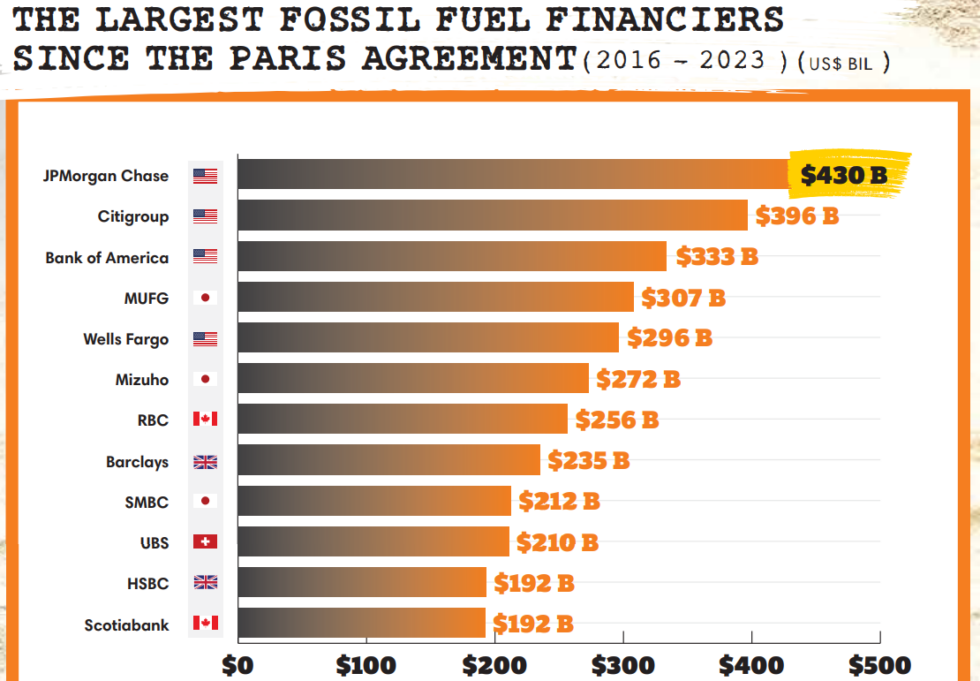
People working in finance decide to invest in fossil fuels because they do not care about climate impacts, or do not want to deal with the consequences if they were to do otherwise. This could range from disapproval from their peers, up to reprimands and sanction from management. Perhaps even being fired. There are lots of ways that people can justify their actions or the actions of their organisations. For example, JP Morgan also invests very large amounts of money into renewable energy projects. But opening a solar farm won’t do a jack if it doesn’t result in the closure of some part of the fossil fuel system. This is why net zero was such a dangerous approach, because in promising to be able to offset or remove emissions at some point in the future, it allowed people to argue that they were making progress on the climate crisis while not doing what the crisis actually demands - which is stopping pumping carbon dioxide into the atmosphere.
As I was getting to the end of this little rant I remembered climate scientist Katherine Hayhoe’s advice that when talking about climate change you must provide stories that can inspire hope and action. Fortunately the audience began to supply the answers by suggesting ethical banking options, how to lobby their local MP, finding out where your pension fund is being invested and getting it switched. If enough of us take these and other actions, then I think we could make a difference. Most important, collective action is going to be needed to get politicians to implement the sort of mandates that slashes fossil fuel production and consumption. We have have do that together. That really is a message that can inspire hope and action. And I say that while recognising the tremendously powerful forces ranged against us.
That is why events like the People’s Emergency Briefing matter. They create spaces where people can connect with each other, and piece together the things they can do that could make a difference. If nothing else, it's good to be reminded that wanting a liveable planet isn't a radical demand. It should be the bare minimum of what we expect from our institutions and politicians.