Overshoot Integral and Derailment Risk
Some new perspectives on the consequences of overshooting into dangerous climate change

The start of the new academic year is always hectic. It doesn’t seem to matter how many times we enrol students, set classes, and organise assessments there are always problems, last-minute panics, and scrambles. So the extra work to complete paper revisions in September wasn’t exactly welcomed. But now that those revisions are done and the papers are being published – well, it was of course all worth it in the end.
Paper 1 is The overshoot integral can inform climate science and policy beyond 1.5°C of warming. Paper 2 is Manage derailment risks to avoid Hothouse Earth. An accepted version of the overshoot paper is available online (accepted articles have yet to complete proofing and so may change a little when finally published). You will have to wait for the derailment paper as the journal will be sending out a press release and have embargoed it until Friday (or Monday). Both papers have been published in Environmental Research Letters, but via completely independent routes. It just so happened that the journal was hosting two themes that for a while overlapped and fit the overshoot and derailment themes respectively. I guess ERL papers are a bit like busses.
On Friday I will post an article about the derailment paper. Here I want to spend a moment reflecting on the overshoot research. This started in the spring of 2025 during an Earth League meeting in Hamburg. It was there that I got talking to John Schellnhuber and Wolfgang Lucht about climate overshoot. As we go deeper into the danger zone, we should expect loss and damages to not just increase but accumulate. This means future climate damage will be heaped upon the previous damages that climate change will have produced. Much of the discussion and debate about overshoot seems to ignore that and instead focusses on to what extent the global carbon cycle is reversible, and how much carbon could future societies remove from the atmosphere. Both crucial questions of course, but what was being missed was the assessment of accumulating damage, not to mention the fact that we already have produced irreversible change - we are never going to get back to pre-industrial Earth system states.
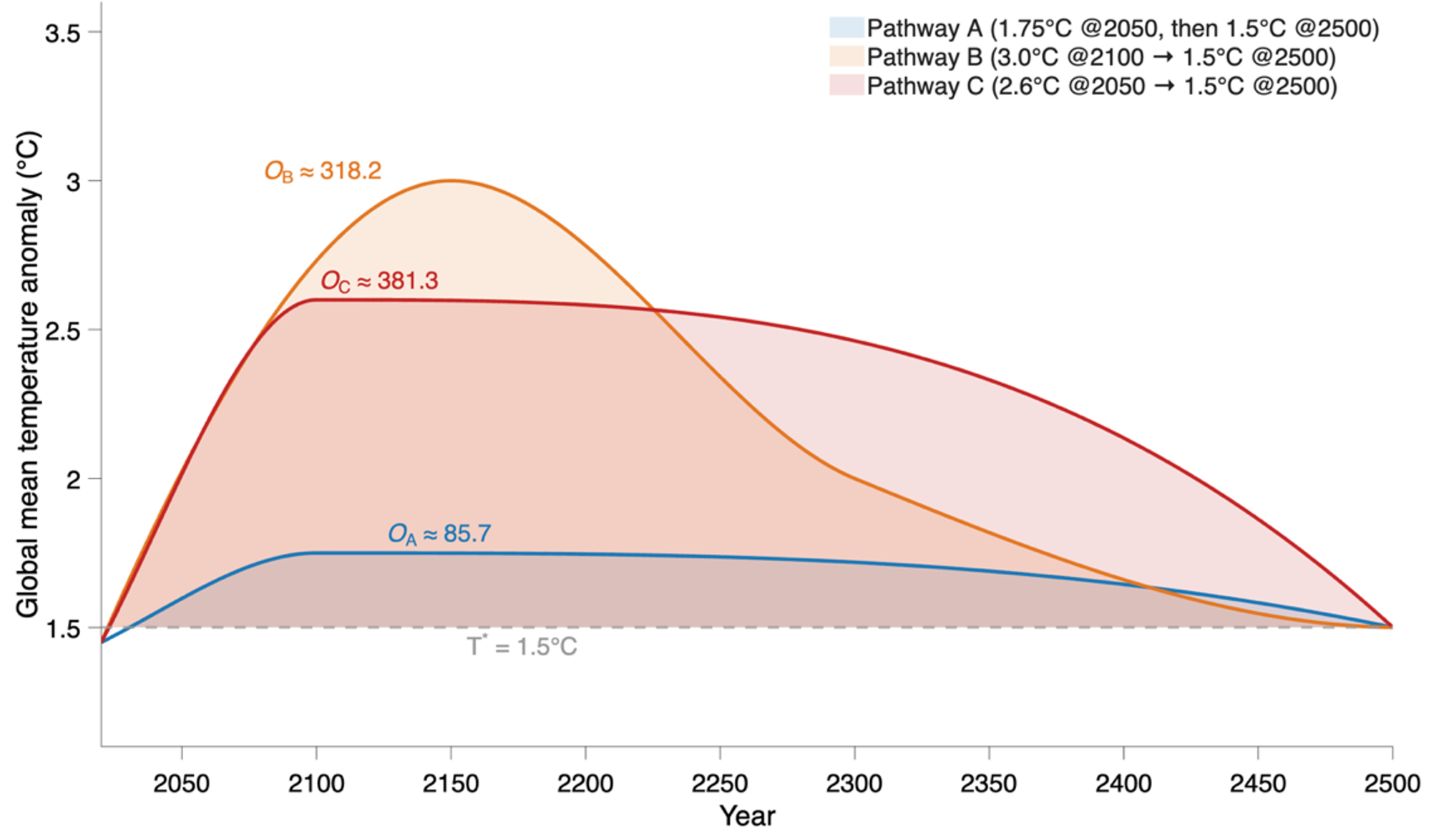
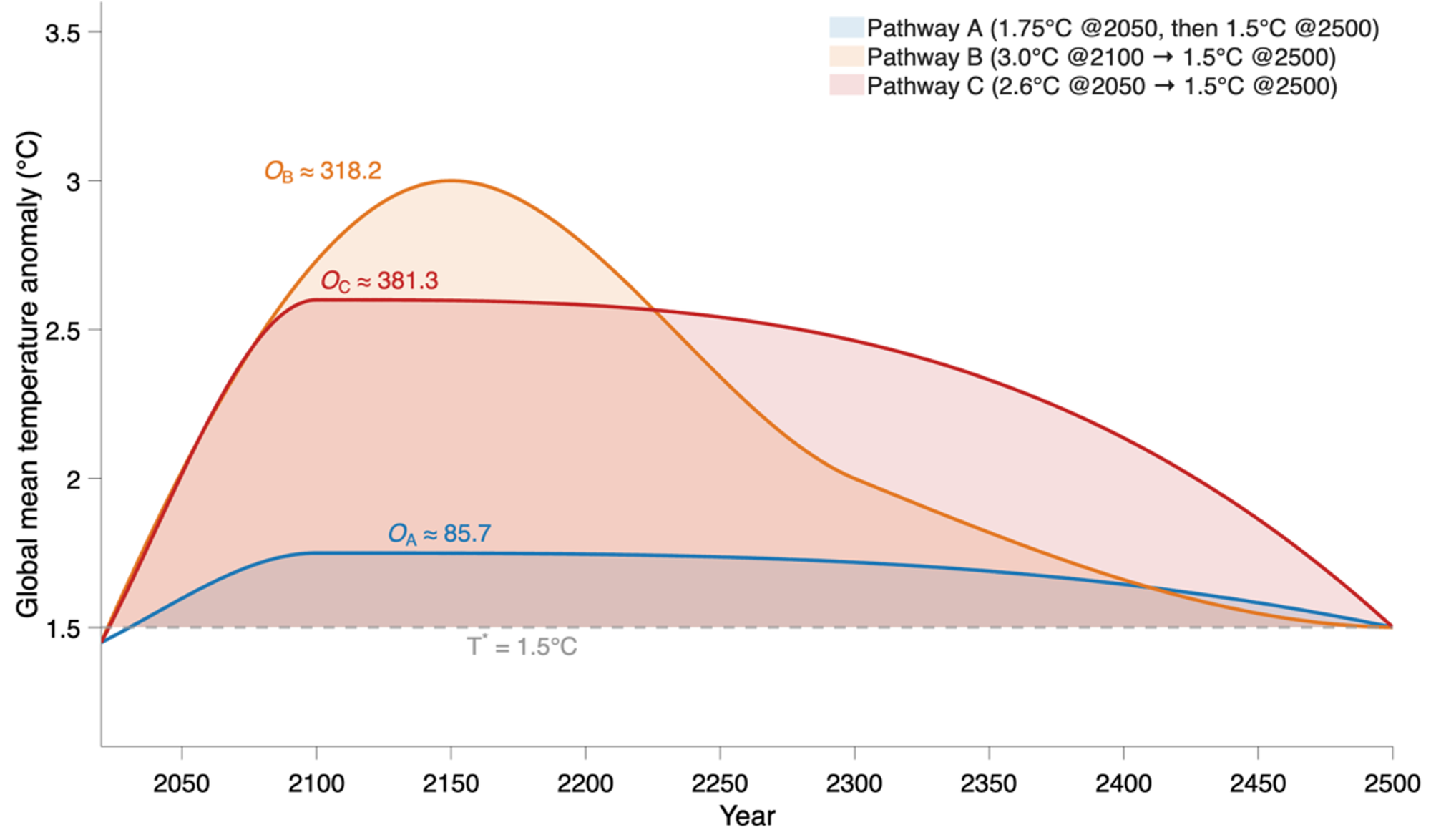
The straw that broke the camel’s back is an instructive metaphor here, because a societies’ resilience to climate change can be eroded over time such that two impacts with the same magnitude or size can produce very different consequences dependent on when they arrive. One way to capture this is to assess climate damage or risk as being about not just how much warming goes beyond 1.5°C, but for also how long. The area of the overshoot is what matters. John came up with the term overshoot integral because the integral is a way to measure this area.
What this means is that different pathways with different peaks and shape of overshoot will produce different overshoot integrals. The figure below shows three conceptual pathways. These all exceed 1.5°C by different amounts with temperatures all falling back to 1.5°C by 2500.
Already this is something of a departure from how overshoot is typically communicated. For example, ‘Paris compliant pathways’ show warming exceeding 1.5°C but then coming down by the end of this century. I think that is profoundly problematic because there is very little evidence to support such a scenario. The default position when it comes to communicating overshoot should be that we expect temperatures to remain at whatever level for not just decades but centuries. Any pathways that sees the development of the permanent removal of hundreds of billions of tons of carbon from the atmosphere must be treated as highly speculative.
We explore the consequences for different overshoot integrals for different climate futures (the new CMIP7 scenarios to be specific) on various tipping elements in the climate system. "We" here primarily means Jesse Abrams who joined John and me to work on the analysis. In particular we argue that the risk to permafrost carbon and mountain glaciers cannot be captured with peak warming alone. How long these systems are exposed to heat really matters. We need to be assessing climate risk as a function of both peak warming and overshoot integral. The way we put it in the paper’s abstract is “the overshoot integral is best understood not as a reversible account that can be debited and credited, but as a cumulative dose [that] should inform climate policy and science in the increasingly warmer future.”
The key message here is that we have produced damage, further emissions will produce further climate change and further damage. You don’t get to undo this damage with future carbon dioxide removal or even more radical ideas such as solar geoengineering. If deployed, these would be technologies of last resort, emergency measures deployed in an increasingly desperate efforts to avert the worse impacts, the onset of catastrophic tipping and climate change.
There are no ‘take backs’ when it comes to climate change. Hopefully the overshoot integral could help policy makers understand that.