The world lost the climate gamble: now what?
Warming is surging past 1.5°C along with the realisation that the Paris Agreement has failed

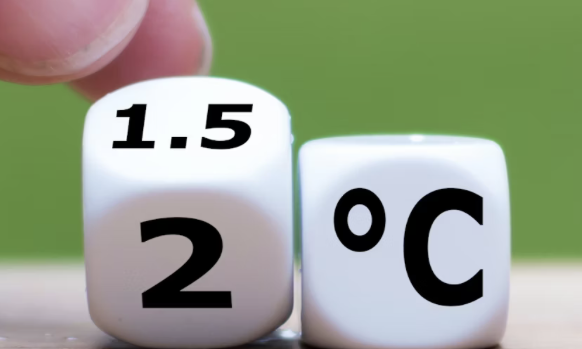
Tomorrow (Wednesday 10th December) 2:30pm UK time I will be giving an in-person and online seminar about my recent work on climate overshoot, planetary boundaries, and risk and how this relates to wider climate and sustainability issues. You can join via this Zoom link.
I am not a gambler. Apart from betting 50p on the Grand National over 40 years ago I don't think I've ever staked any money on any sort of gambling. Many years ago someone explained to me that you should never put up a stake you cannot afford to loose. Another way of thinking about that, it that when gamble anything you need to assume that you have already lost your stake, and the game of chance you are playing is worth it because of the reward you would get back in your win. I also think my aversion to gambling comes from the sense of hope it can produce. Let me explain.
I once sat down to watch the UK's national lottery with my parents. They got me to check the numbers as they were called. They had the first number. And then the second. And then the third. I was suddenly struck with the thought that I held in my hands a piece of paper that had the potentially to utterly transform their lives. I knew that the odds of winning the jackpot were about 1 in 45 million, and so it was extremely unlikely. But it wasn't impossible...
They didn't get any other numbers. That was an entirely unsurprising outcome. But that feeling of lost hope stayed with me for a long time and it bothered me. Eventually I came to the conclusion that I had looked to a game of chance as the way in which the lives of people I care about would substantively change for the better (making the problematic assumption that money makes you happy). If such things were important to me, then I would be doing the work to make a difference now.
These are the two reasons why framing our dangerous interference in the climate system as a sort of gamble is potentially deeply problematic. First, given a liveable climate is at stake we shouldn't be playing the game at all, because we cannot afford to loose. Second, hoping that we will be lucky means outsourcing out agency to external factors - e.g. crossing our fingers that climate sensitivity won't be very high. It's with such thoughts in mind that I've been reflection on the responses to some of my recent work about climate risk, and consequences.
Our paper Living beyond limits: Consequences of missing the decisive decade for preserving our planet’s life-supporting systems has generated quite a bit of interest. One way I can tell is that I've been getting emails from retired engineers explaining to me that global warming is a hoax because there is no such thing as the greenhouse gas effect, or that carbon dioxide is actually plant food and so we need more of it in the atmosphere. By the time you are on the climate denial radar, then you can be reasonably sure the paper is being picked up. The article for the Conversation Johan and I wrote probably helped.
I try to be mindful of how I frame this work. There seems to be precious little good news about the Earth system's response to human's impacts. This week there was a frankly astonishing joint statement from the German Physics Society and the German Meteorological Society that argued warming of 3°C by 2050 could not be ruled out. I'm sure most of my climate change colleagues would immediately push back on this and say that while there is some evidence that climate change is accelerating, there just isn't enough time to conclude that the long-term warming really is progressing at the pace required to reach 3°C within 25 years.
There will be endless arguments about how sensitive the climate system is to human's emissions of greenhouse gases. That's just how science works. But when it comes to assessing climate change risks it's not sufficient. Rather than try to determine the most likely amount of warming, we also need to consider the chances that things may be worse than central estimates. The outcomes we cannot afford. We certainly cannot afford 3°C by 2050. I find that outcome almost unimaginable. But that's the job we have right now: to consider such outcomes and then think about what we need to do now in order to reduce these risks as much as possible.
The safest way to have done that would have been to not play the game, to simply walk away from the climate casino. That didn't happen. Irrespective of whether the acceleration of warming continues, it's abundantly clear that dangerous climate change has arrived. Now debts are due. Much of the international climate diplomacy in coming years is going to be about whois liable. We have a very long way to go before those most responsible for climate change - rich industrialised nations - pay up for the damage they have caused.
Just as important is the complete shift in mindset when it comes to assessing climate risk and how risks can be mitigated. Hopefully some of my work in this area will be out soon (when it comes to academic publishing, 'soon' does not really mean what you think it means...). I will talk about some of this tomorrow, so do come along (either in person or online) if you would like to learn more.